What Theme Was Covered Again and Again in Scalias Speech
Antonin Scalia's Less Well-Known Legacy: His Speeches 06:38
Play

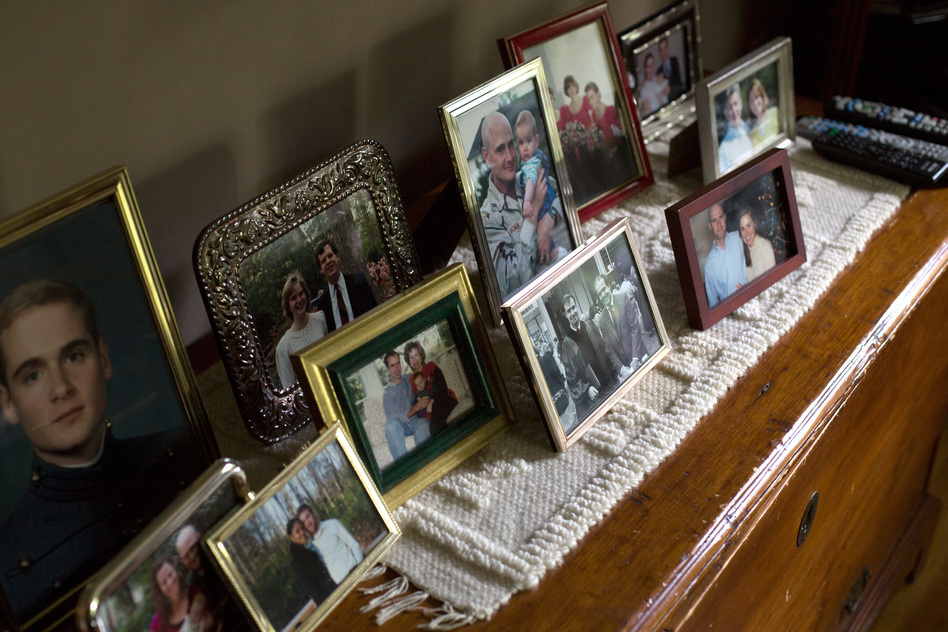
In a sunny den in McLean, Va., Maureen and Christopher Scalia sit side-by-side on a comfortable couch. He co-edited Scalia Speaks, an anthology of his male parent'south speeches on a variety of subjects, and he ranks 8th in birth order out of the nine Scalia children. She is the mother of those ix children, and the widow of the belatedly Supreme Court Justice Antonin Scalia — a conservative icon, bon vivant, music lover and witty observer of law and life.
Christopher explains that he put together the collection to requite non-lawyers, besides as lawyers, a fuller picture of his male parent and his many interests.
Bust buddies, just sometime foes
The book'southward foreword is written by Scalia's close friend, Justice Ruth Bader Ginsburg, with whom he disagreed — often vehemently. As Ginsburg observes, her friendship with Scalia was "sometimes regarded every bit puzzling." The two opened up about being an "odd couple" during an interview I conducted at George Washington Academy in 2015.
As that appearance illustrated, Justice Scalia was a very theatrical presence, and, in most of the speeches in the book, those who knew him volition quite literally hear his voice in their heads.

Speeches with dramatic flair
In a voice communication chosen Platitudes and Wisdom that Scalia performed many times, with adjustments for his audition, he was viciously funny in discussing the clichés of a commencement address. Amid them, "follow your star" and "never compromise your principles."
Follow your star is fine, he said, if you desire to head due north and are post-obit the Northward Star. "But if you want to head north and it's Mars, you had better follow somebody else'south star." As for never compromise your principles, he opined, that'south alright, "unless, of course, your principles are Adolf Hitler's. In which case you would be well advised to compromise them whenever you can."
One of my personal favorites in the collection is called, the Italian View of the Irish. Information technology was delivered in 1988 at the Gild of the Friendly Sons of St. Patrick in New York Urban center. In one role of the spoken communication Scalia describes the various characteristics of what he called "Human hibernicus."
"One, of class, is lying," he declared, speedily adding, that "any other group would have offense at that, but I am sure that this gathering will proudly agree that nobody in the earth can tell a glorious, toweringly imitation tale likewise as an Irishman."
Asked if she thought that was true, Mrs. Scalia, born Maureen McCarthy, replies with a tiny smiling: "Well I don't think it's lying....There'south fun in spinning a story to see how far you could become."
Indeed, Maureen Scalia was addicted of curing her husband's occasional grumpiness at the breakfast table by reading him items from the newspaper that she changed to make outrageous or just made up!

Turkey Hunting, another speech in the collection, is about Scalia's love of hunting not just turkeys, but everything from ducks to rabbits to boar. He went oft on these expeditions, and and then was able to provide Mrs. Scalia, noted as a "principal of the art of...gourmet cooking" by Justice Ginsburg in her foreword, with a glut of fresh ingredients to piece of work with.
Son Christopher remembers freezers in the garage to arrange the "overabundance of meat" that his father brought home, so much that his mother "would never get around to cooking" it all. Luckily, Mrs. Scalia escaped the task of plucking the game that her hubby brought home. "Merely I would always have to go through and see if there'southward any shot left," she says, "And there almost always was."
Amid Christopher'south favorite speeches is one chosen The Arts, delivered at The Julliard Schoolhouse in 2005. Appearing on a panel with historian David McCullough, opera singer Renee Fleming and composer Steven Sondheim, the justice opened this way: "Today's program reads like some sort of weird IQ test: Which of the following is out of identify? Diva, author, composer, lawyer?"
The crowd roared, fifty-fifty as Scalia best-selling that when speaking of lawyers, or judges, "It is certainly true that the main concern of the lawyer is to have the imagination, the mystery, the romance, the ambiguity, out of everything that he touches."
Scalia and so segued to a discussion of the First Amendment's guarantee of free speech, and why it forbids censoring ideas in the arts but not "lousy music," or, for that matter, nude dancing. As Scalia put information technology, "The First Amendment says what it says, not what we lovers of the arts would like it to say. This means, I'thousand sorry to say that, in my view, even music, as opposed to lyrics, is non covered."
"He didn't tell people what they wanted to hear," remarks Christopher, calculation that his father's view was, "If they wanted to hear it, they'd probably already believe it, and then in that location's no betoken in giving a speech about it."
The stump speech communication
Then there is what the younger Scalia calls, "the stump speech." It was the spoken communication, with variations, that the justice gave all over the country, proselytizing his view of legal interpretation. A typical passage, establish in NPR'south athenaeum, has Scalia intoning, "The Constitution that I interpret and apply is not living, simply dead, or, as I prefer to call it, indelible. It means today not what current society, much less the court thinks it ought to mean, but what it meant when it was adopted."

Christopher says he had looked forward to finding the bodily text of one such speech that he heard his father requite in Madison, Wis. But, every bit he pored over boxes of texts and disks, he could not find it.
Instead, the elderberry Scalia had what he called "the outline."
Information technology "was basically just a handful of words. I don't fifty-fifty call up they were in complete sentences," Christopher says.
The justice insisted on having a printed re-create of those fragments with him, virtually as a good luck charm, Mrs. Scalia observes. "He would exist getting prepare to proceed a trip, and I often would be pressing the accommodate," she says. "In the pocket...of most every jacket he wore, there would be a copy, just a little printout of that."
Scathing dissents
In legal circles and among colleagues, Justice Scalia was famous for his vivid writing, especially his dissents. There are some very famous lines in those dissents, ofttimes delivered from the bench, with dramatic brio.
And as the lone dissenter from the court's 1988 determination upholding the independent counsel law, he wrote that the intrusion on presidential ability was so obvious that, in dissimilarity to nearly such cases, which, as he put it typically come to the courtroom disguised "in sheep's clothing, ... this wolf comes as a wolf."
The line is so famous that Justice Ginsburg quoted it in that 2022 joint advent with Scalia.
Dissents are in fact the subject area of one of the speeches in Scalia Speaks. And information technology's here that Scalia talks about dissenting opinions equally something of a liberation because the writer doesn't have to worry most the views of others, and tin, to put information technology in the vernacular, let 'er rip.
For Scalia, that meant sometimes trashing a colleague's majority opinion with biting and personal commentary — in i example, for example, maxim that if he had joined the bulk stance, "I would hibernate my caput in a pocketbook."

Maureen Scalia says she would oftentimes hear her husband trying various phrases out loud while he worked on a dissent. "And every once in a while come up in and read something to me, and I'd say, 'You lot're not really going to say that are y'all?' He said 'No, but it's really good isn't it?'"
In that location were some times that information technology appears Scalia didn't take her advice, that he went alee and used some more-than-pointed language.
Shaking her head, Mrs. Scalia disavowed any responsibleness for such pugilistic comments. "He didn't endeavour it on me, that'due south why, she says, "He knew what I would say."
Scalia Speaks, co-edited by Christopher Scalia and conservative commentator Edward Whelan, debuts in bookstores on October 3.
Copyright NPR 2022.9(MDAyNzUwMDI2MDEyNTA3MTU5NzcyNTQyNA004))
mcreynoldsbrich1991.blogspot.com
Source: https://www.wbur.org/npr/554478768/scalia-s-less-well-known-legacy-his-speeches
0 Response to "What Theme Was Covered Again and Again in Scalias Speech"
Enregistrer un commentaire